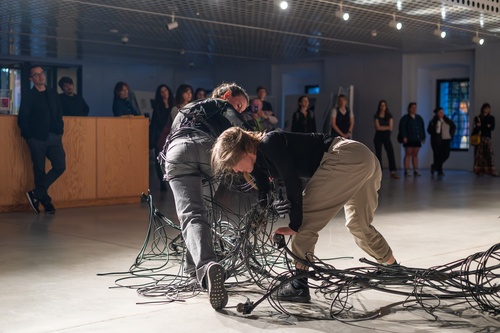
Yein Lee
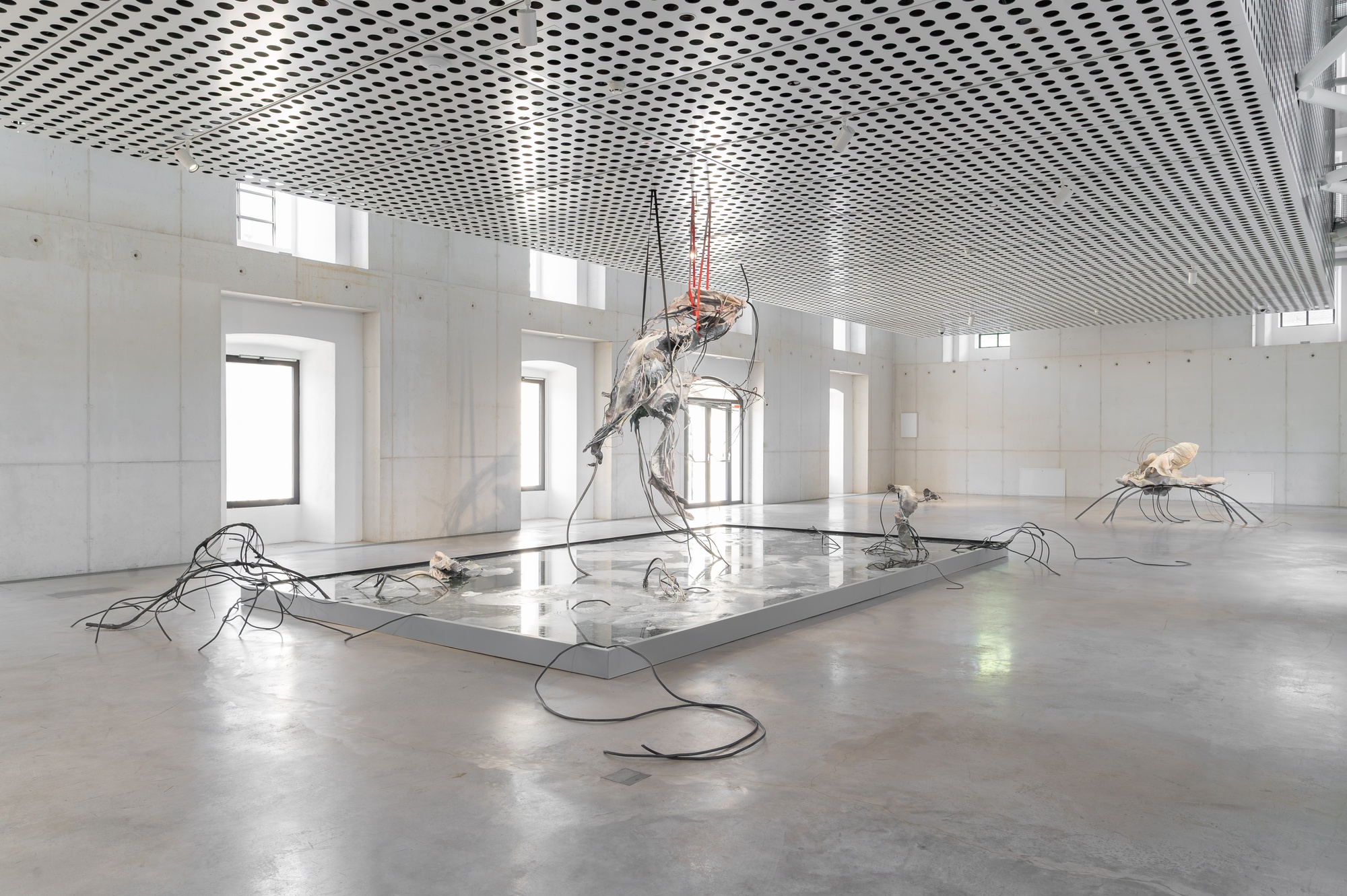
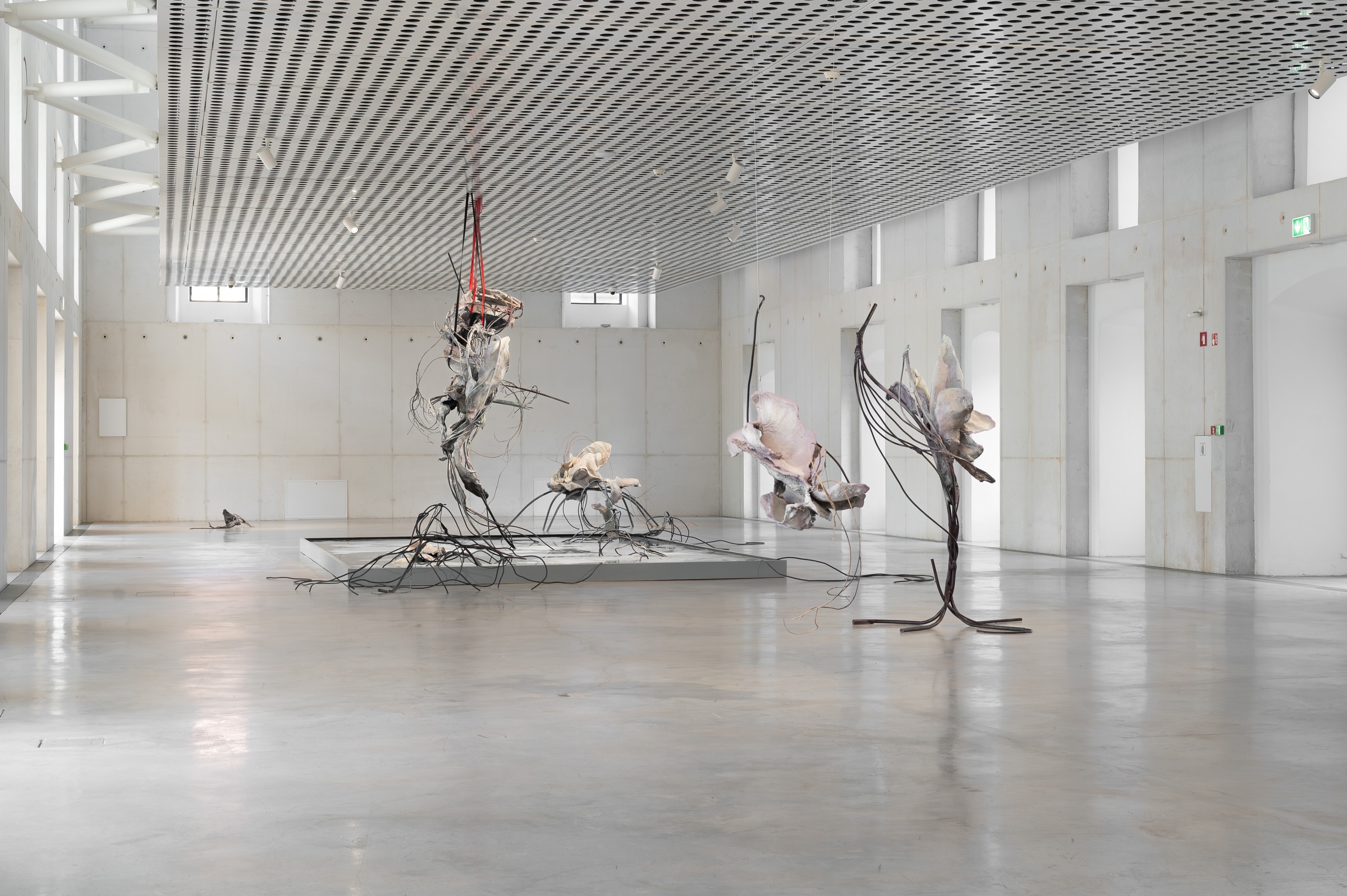
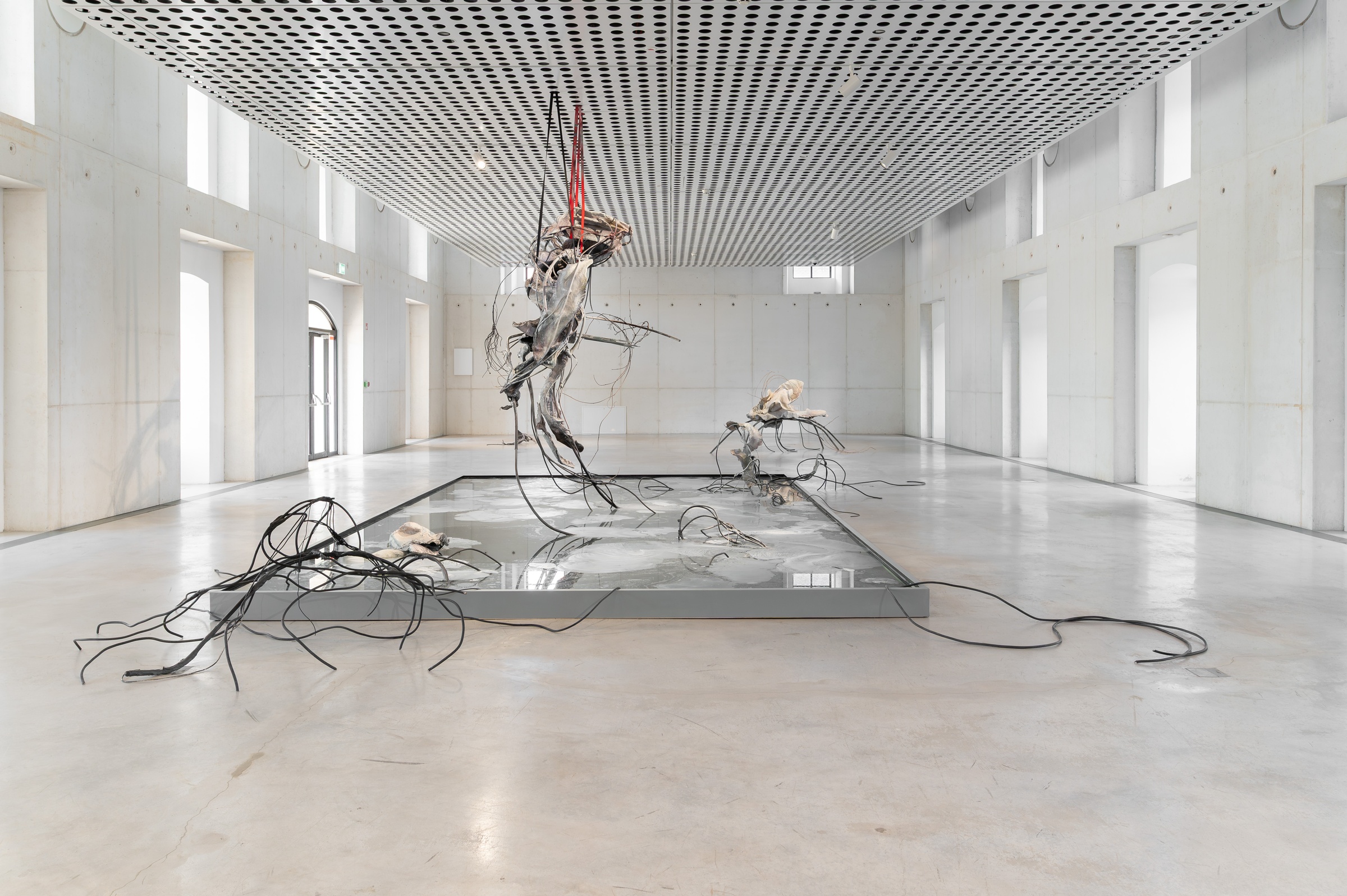
Accomplice brings together a new series of sculptural works by Vienna-based South Korean artist Yein Lee. Developed specifically for the Parterre Gallery, the exhibition consists of five sculptures and a ground-based pool installation. Extending into the architecture of the gallery, the works form a landscape of precarious relations that explores conditions of material instability and spatial uncertainty.
At the centre of Yein Lee’s sculptures and installations lies a condition of material becoming. The artist approaches form and matter not as fixed entities but as sites of continual negotiation, shaped by forces that exceed stable control. Within Lee’s practice, processes that transform, deform, and adapt resonate with broader conditions of ecological stress and geopolitical volatility, in which environments, infrastructures, and bodies are increasingly exposed to pressure and fatigue, causing instability. Rather than presenting matter as passive or inert, the works foreground its capacity to respond, shift, and reorganise under strain. Material thus appears as active and relational – continuously transforming in response to the tensions and uncertainties that structure contemporary environmental and political realities.
Within this framework, Lee’s works emerge through processes of abrasion, accumulation, and provisional balance. Surfaces appear fractured, material elements lean or suspend themselves in precarious alliances, and the sculptural field unfolds as a landscape of tensions.
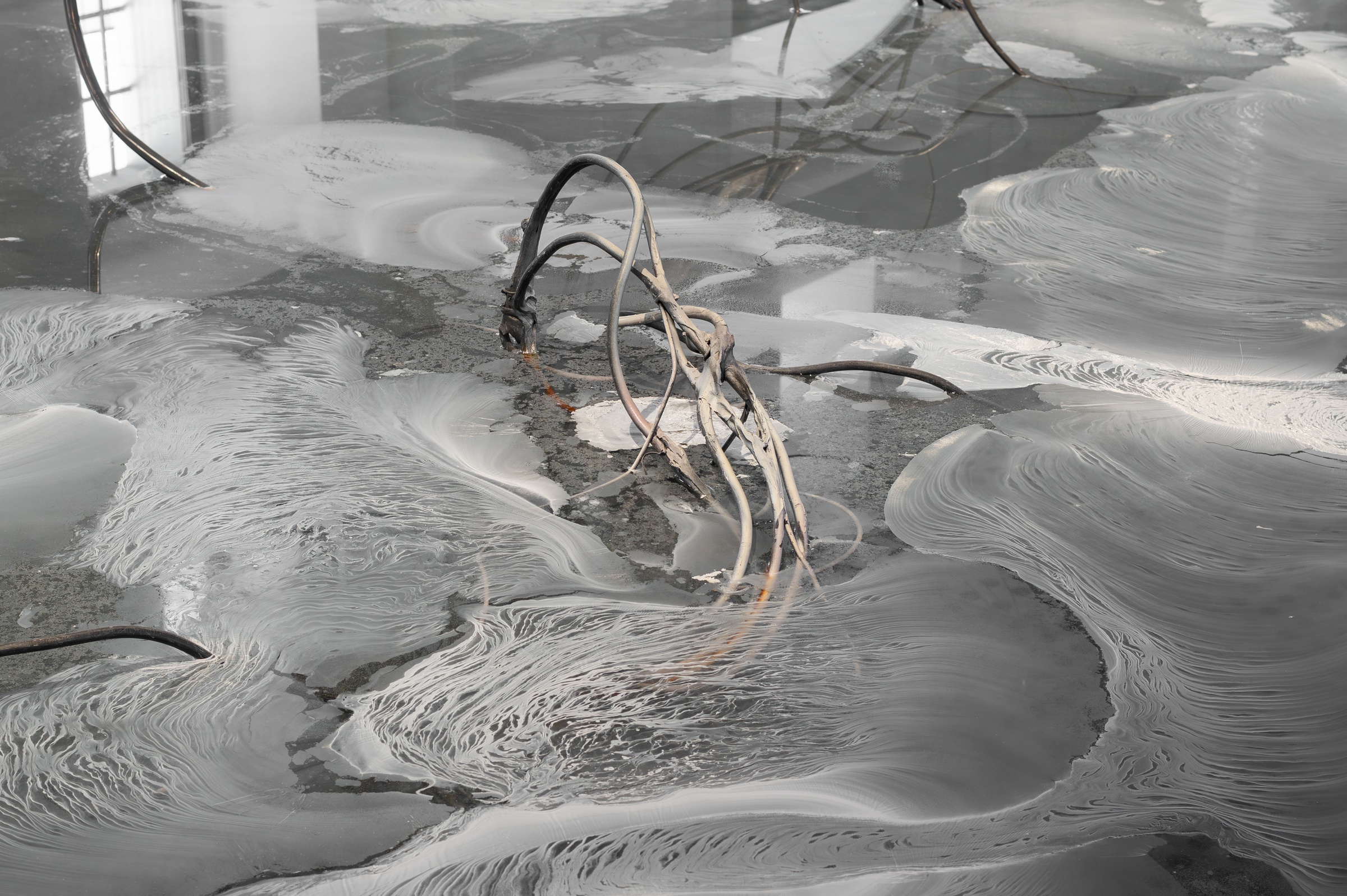
The five sculptures are distributed across the Parterre Gallery without forming a fixed pattern or centralised arrangement. Varying in scale, some works stand independently while others gather into loose clusters, creating shifting points of attention throughout the space. A larger sculptural element descends from the ceiling, its form mirrored in the reflective surface of the pool below. The reflection establishes a vertical axis that connects the suspended sculpture to the mirrored geometries of the surrounding space.
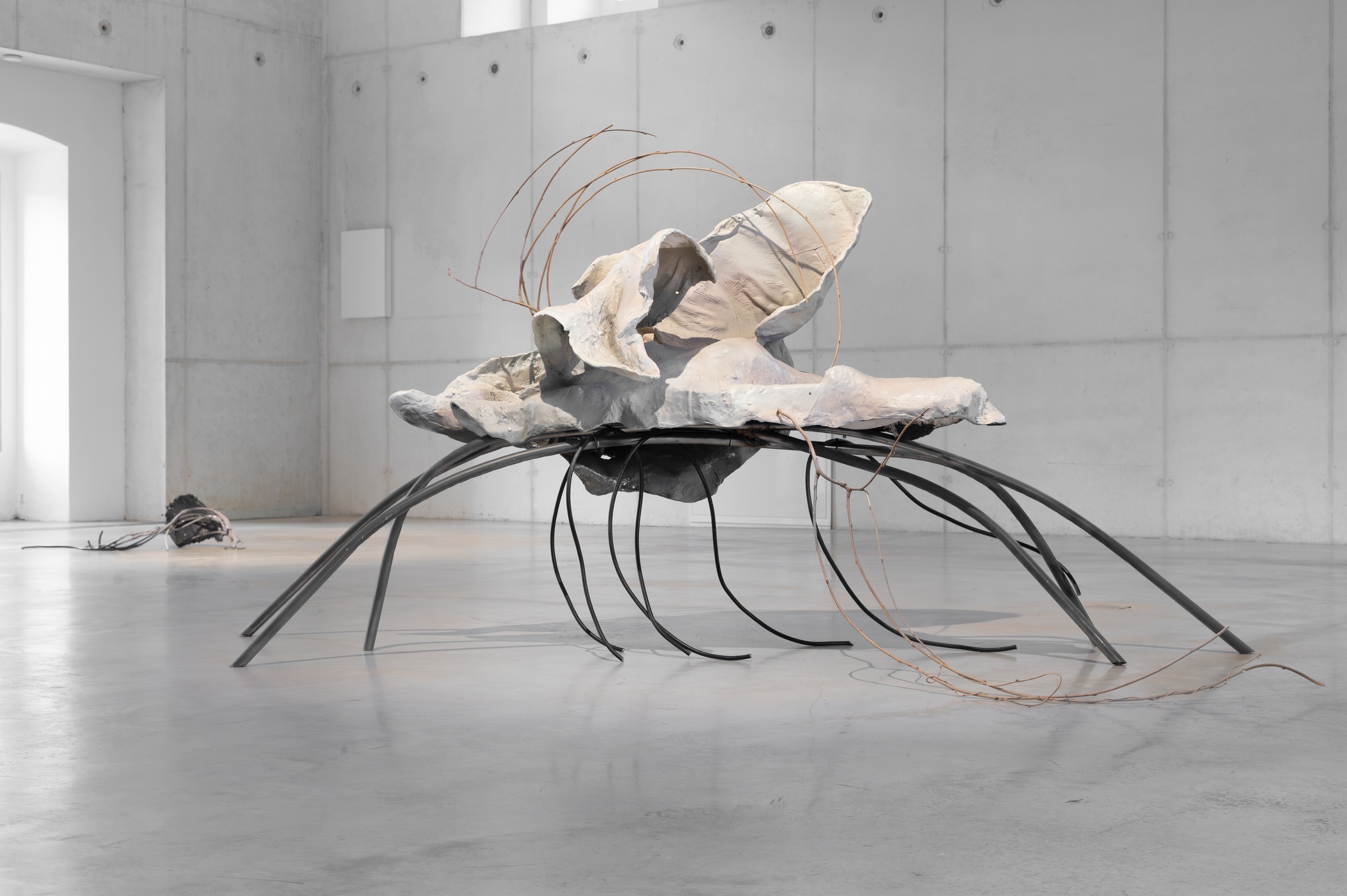
Each sculpture is characterised by biomorphic forms that evoke structural features found in foliage and twigs, such as veins and vascular systems that transport nutrients through plant bodies. At the same time, these forms recall elements of industrial infrastructure – cables, wires, and steel pipes that channel energy, information, or fluids through technological networks. By deliberately bringing these visual and structural references into proximity, Lee foregrounds formal correspondences between botanical and industrial bodies, tracing the shared structural logics that traverse natural and manufactured systems.
The artist works with polymer gypsum, epoxy putty, and found steel. Gypsum casts are taken from materials and surfaces in unstable or transitional states, carrying their instability and transience as imprints. The casts register moments of pressure, erosion, or displacement, allowing processes of transformation to remain visible within the sculptural form. As such, they can be understood as trace bodies: forms that retain the marks of their making and emerge less as pure authorial expressions than as the result of ongoing exchanges between artist and material.
As the artist notes: “The works protrude out of my own form and into their own. There is an inversion, a turning over, or an exposing of their underbelly. I am drawn to the tension that holds them; the quiet strength and ambivalence between what is fragile and what is rigid, between what yields softly and what resists.”
This is further explored in the titles of the sculptural works. 공범자 Gongbomja (Accomplice), 수행자 Suhaengja (Practitioner), 파견자 Pagyonja (Dispatcher), 고행자 Gohaengja (Ascendant), and 감시자 Gamsija (Watcher), all denote forms of active participation of the sculptures. They suggest an intimate cooperation between artist and material that borders on complicity, pointing to a process of making in which object, space, and body remain mutually implicated.
These roles extend into the exhibition space, as the viewer does not simply observe but navigates a field of tensions. Movement and shifting vantage points continually recompose the constellation of the works, drawing the viewer into the same dynamic relations that shape their formation. In this way, the sculptures appear to expand beyond their physical boundaries, reflecting both the material processes from which they emerged and the broader conditions that shape the environments they inhabit.
Curated by: Ema Ograjenšek
Exhibition text: Ema Ograjenšek; Exhibition production and coordination: Marija Veljanovska Nemec, Lenka Đorojević; Exhibition Production Assistant: Leon C. Scheiblich; Exhibition Sound Design: Leon C. Scheiblich; Public relations: Mojca Podlesek; Educational and andragogical programme: Nina Vošnjak; Production assistance: Neža Vengust; Design: Ajdin Bašić; Head of technical team: Jože Kalan
Special thanks to: Miryam Charim, Martin Alexander, Charim Factory, Cusson Cheng
Supported by the Austrian Federal Ministry of Housing, Arts, Culture, Media and Sport, Republic of Austria, and the Austrian Cultural Forum Ljubljana.
Opening hours
Tuesday to Sunday: 10.00–19.00
24 and 31 December: 10.00–14.00
Closed: Mondays, 1 January, 1 November, 25 December
Tickets
Free entry.
Press kit
Biographies
Yein Lee is a South Korean artist who currently lives and works in Vienna, where she teaches at the Academy of Fine Arts Vienna. After receiving a B.F.A. in Traditional Asian Painting from Hongik University, Lee earned an M.A. from the Academy of Fine Arts in Vienna. Lee’s practice revolves around a system of becoming, an ever-shifting process of redefinition in which form, self, and structure are in constant negotiation. Her installations, sculptures, and performances highlight temporality through their impermanence, creating a space for vulnerability and critical reflection. She has recently participated in group exhibitions at the 15th Gwangju Biennale, Centre d’Art La Meute, Le Château-Centre d’Art Contemporain et du Patrimoine d’Aubenas, Centre Culturel Suisse (Paris), Belvedere 21, and Kunstraum Niederösterreich, among others.
Ema Ograjenšek is a writer, critic, and curator of contemporary visual art. In 2023 and 2025 she was the guest curator of the U30+ programme for the production of exhibitions by young Slovenian artists at Aksioma – Institute for Contemporary Art Ljubljana. She is the author of Restricting Flight for Surreptitious Assembly – The Diagrammatic, the Mark and the Vectorial Image (Aksioma, 2024). Her reviews and essays have been published in magazines and on online platforms such as PASSE-AVANT, Artalk, Blok Magazine, Fotograf Magazine, all-over Magazine, ETC. Magazine, Maska Journal, ŠUM Journal, Borec Journal, Tribuna, and Radio Študent. She has curated exhibitions at EXILE (Vienna), New Jörg (Vienna), the Museum of Madness Trate, SCCA-Ljubljana, Aksioma, Museum of Contemporary Art Metelkova (as a member of the Neteorit collective), Center for Contemporary Arts Celje, and Škuc Gallery. She is based in Vienna.